
UNBEATABLE(‘s DEMO) and Its Anti-Fascism
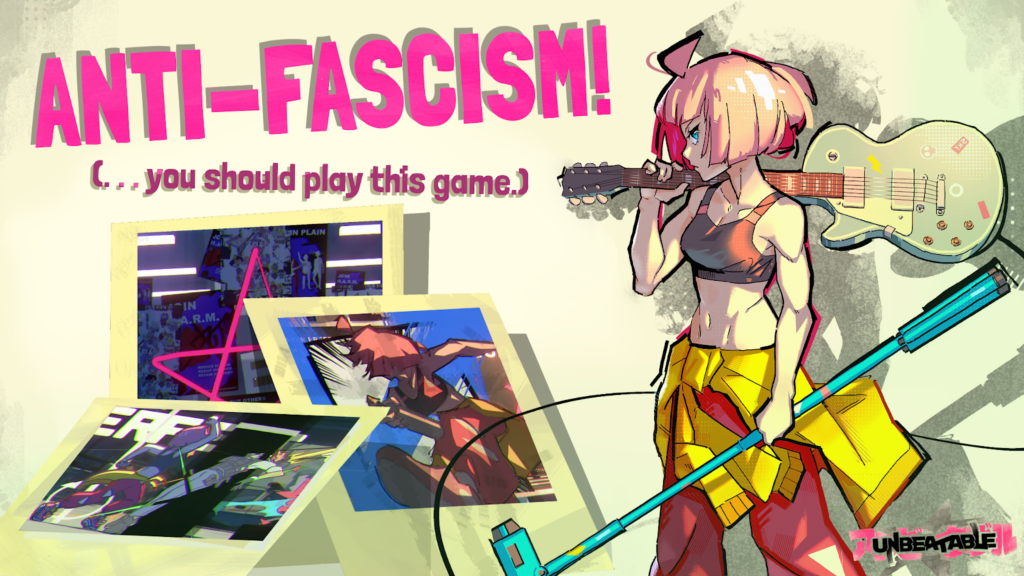
Image Credit: James Watt
By: James Watt
In a world where the most invested-in games are, more or less, trying anything to be one of many $70 expenses, indie seems to be the term to pull in the learned gamer. Indie games like Hollow Knight, Undertale, Hades, and many others have brave and challenging stories, unique and refined expressions of gameplay, and unbreakable and loving communities.
The game UNBEATABLE, despite being far less popular than these, has the indie soul and attention to detail comparable to them, with something more . . . loud about it.
UNBEATABLE is an indie game made by D-CELL studios, and was created out of a Kickstarter campaign in 2021, garnering $400,000. It went through a difficult development period, and changed visual styles, but did not lose its audio style or compromise on its original vision. Despite the new visual style, UNBEATABLE remains the game that was kickstarted on hopes and dreams back then (D-CELL, UNBEATABLE Website).
UNBEATABLE’s tagline is “a game where music is illegal and you do crimes.”
Isn’t that brilliant?
Scream your lungs out! Rebel against the oppression! It’s an immediate declaration of the defiant heart within the game, as well as a knowing wink and high-five to that creative expression in indie games. The visual style of the game is very inspired by manga and anime, with low-polygon 3-D environments, and, both visually and story-wise, takes large inspiration from counterculture movements (Henley, TheGamer).
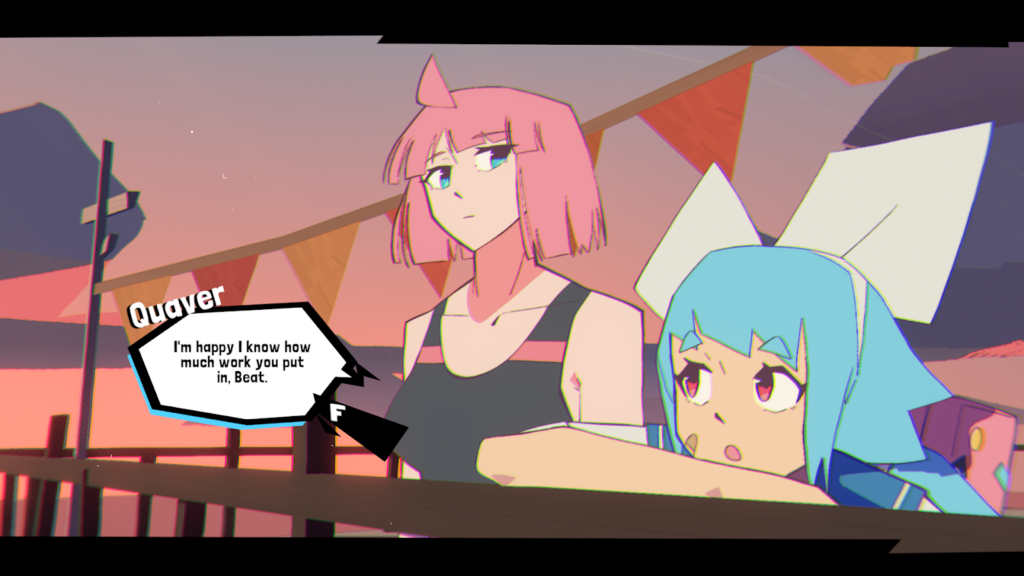
You play as a girl named Beat who runs the titular band: UNBEATABLE. Her crew, who regularly commit crimes, include Quaver, Treble, and Clef. They’re trying to make a name for themselves as a band. Beat is the vocalist, Treble the keyboard, Clef the percussion, and Quaver the guitarist. Treble and Clef are siblings, once without purpose, who joined UNBEATABLE with Beat and Quaver and found their voice. The band now goes and plays music from place to place, fighting oppression in action and fighting all the while.
They stand in opposition to the oppressive influence of the fascist regime named HARM—Harmony and Resonance Management—which rules over the main city of UNBEATABLE.
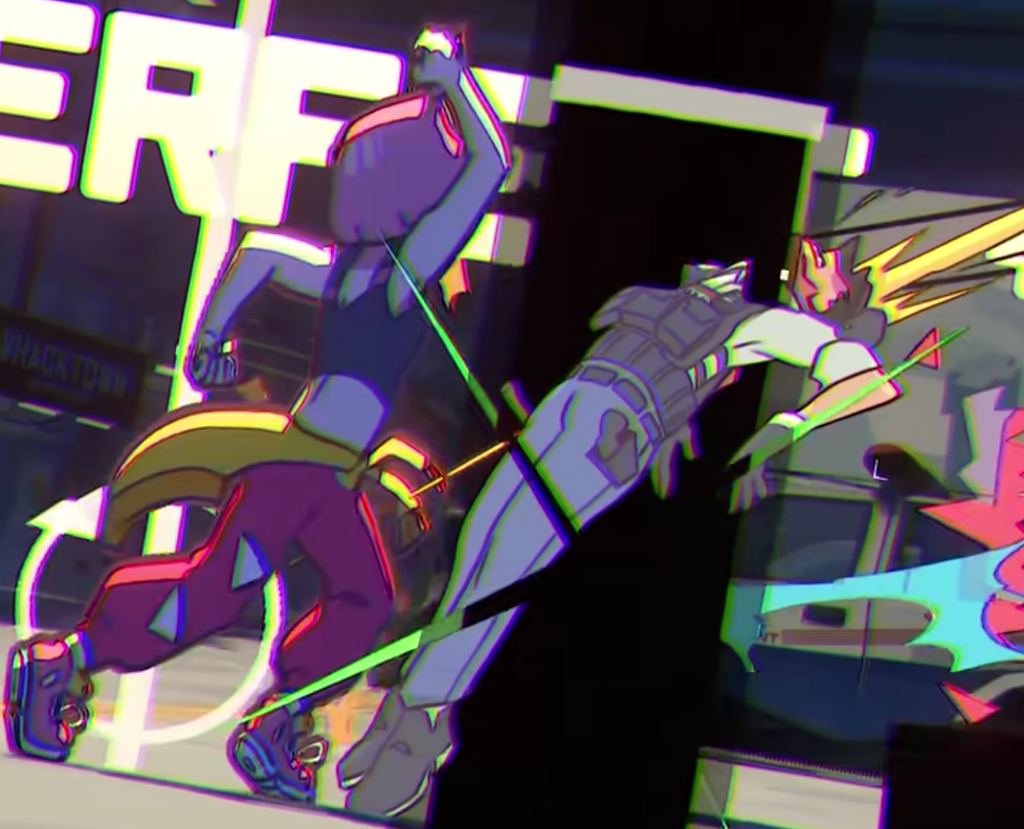
HARM’s propaganda covers the city, billboards advertise the protection in joining HARM, becoming part of the police force, as many in this world have. The police will harass Beat, and start fights unprovoked twice, prompting stylish and quick fights against the cops. HARM hates her, and she hates them back.
Fascism is described by Merriam-Webster as,
“A populist political philosophy, movement or regime . . . that exalts nation and often race above the individual, that is associated with a centralized autocratic government headed by a dictatorial leader, and that is characterized by severe economic and social regimentation and by forcible suppression of opposition.”
It’s not hard to see how HARM compares to a fascist regime. HARM has a strong authoritarian element to it through its law enforcement, and forcibly suppresses opposition through attacking Beat and her band.
Effectively, UNBEATABLE dares to criticize fascism through its criticism of HARM’s authoritarian opposition of the band’s existence, just with some humor and levity about it. The conflict between the band and HARM helps to define the game’s anti-authoritarian identity.
What will follow this paragraph is a spoiler-filled breakdown of plot points and particular sections of gameplay and how they work to, in my opinion, make an anti-fascist message.
At the start of the game’s demo, which presumably takes place somewhere in the middle of the story, HARM decides to force UNBEATABLE to give up, after they accidentally cause a train crash from fighting cops. This comes at a bad time for UNBEATABLE: Clef and Treble, already losing hope from the fact that the band is now camping on a beach with a wood shack without stable power, decide to give up. Clef fails to convince Quaver to leave on her way out, but gives her kernels of hopelessness to gnaw on.
In a ramen bar, when Beat meets up with Quaver, the game has a notable moment that signals just how unique its approach to anti-fascism is. It starts with a few funny moments, a sarcastic dialogue option here or there, and it lowers the guard of the player. Beat tries to raise Quaver’s hopes for the band, saying that there are more “Treble and Clefs,” but she flatly denies it, claiming that the two joining the band were “luck, beat,” the camera pointing straight down at an unfinished bowl, like it was pondering their turmoil and hopelessness with them.
UNBEATABLE is funny about the way it talks about revolution: the game is comedic by nature, and it makes plenty of jokes. However, it takes very care to make sure that moments of oppression are felt by the player.
The effect of this is that this phenomenon of hopelessness, despite being most easily interpreted in the uncritical lens of mere human-to-human relations, becomes more largely interpretable as a result of the danger that HARM presents to its citizens.
The vocal rebels of the oppressed society, in this case, the band members, simultaneously know the danger of rebelling and the comfort of conforming. This is a result of the established systems for indoctrination of the society: the HARM posters. To draw you into HARM with these posters, with their armor, batons, and clean-shaves, and promises of keeping your city safe, the HARM officers patrol the streets, and randomly block the player’s progress with barriers and rude dialogue. HARM shows that they are the makers, for the lived reality for many of these people, of a tokenized and horrifying justice, and further solidify their influence as the un-spoken oppressor. When the rebels lose hope, it’s not because they aren’t doing enough: HARM is what’s really taking away everyone’s hopes.
Following this, Beat tries to continue to reassure her, to give her the hope that she carries herself, when two abnormal people walk inside. These people are HARM’s investigators, “glorified publicists” by self-admission, Poco and Apoco. They make their entrance loudly. The two avoid Beat and Quaver’s jokes for a bit, distracting the two with funny moments.
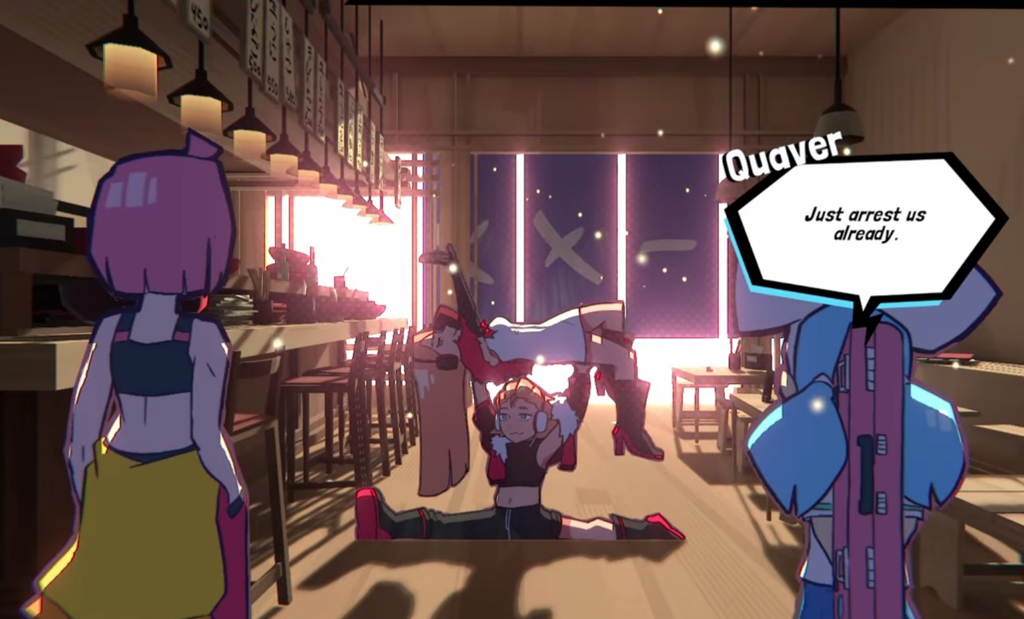
They, instead of fighting Beat and Quaver, instead want to make a deal with the two: to give up their foolish crusade, to just let go of the whole “train” thing, and walk away, scot-free, “no catch.” They invite Quaver to join them, to write her off as a kidnapped child, held hostage by the band. Beat moves to refuse for her, but instead makes a fool of herself to Quaver by spilling the bowl on the ramen bar.
After this, Beat heads out alone to help Quaver. After a slightly suspicious activity of jumping from a window, she gets jumped by HARM police. To the player, the fight seems winnable, but just out of reach: the rhythm of the fight is too hard to follow. In actuality, the fight is unwinnable, reflecting the reality of facing, head-on, an authoritarian system entrenched within their society, playing music when it is criminalized. Beat is left on the ground, defeated and groaning. Poco and Apoco walk up to her and tell her how easy it would be to conform. They leave, and Beat is left on her own, to wander the world, looking for her bandmates. Interestingly, the police barriers are dropped, and most of the cops leave her alone (unless a cop independently makes problems with you).
This moment is a declaration of power—by HARM, of course, and by the game, deciding to not follow a typical approach to storytelling. In this moment of climax, it releases steam by . . . leaving Beat on her own. The release of tension is in the player’s hands now, and they will likely choose to talk to the people that they can, explore the comfortable world around them.
However, even still, as the player pilots Beat in the world, they will likely feel a lack of energy in the game. It’s like the world is barely breathing. You can run and jump around in the streets and spray paint over HARM posters, and cops won’t even glance at you anymore (unless a cop independently makes problems with you). The effect that this has on the player is a feeling of a lack of agency, for they no longer have control over the story. HARM has taken away your friends, your band, and has just beat you down to take your hope.
In this moment, and even after you reunite with Quaver, a loneliness persists. The world is barren of normal citizens, walking around, talking, and having fun. The people are inside, and the cops are outside. Additionally, every citizen that is inside is working, and, even in retail, have no customers, and none have very positive dialogue: the teenage bartender at Quenchly jokes to Beat that they think they’re only there for the money and sense of purpose, the former of which most workers don’t have much of anyway. Even the HARM officers aren’t happy, though it’s often hard to tell through the belligerence.
Adding to this are direct character moments with Beat. It seems that, at the rare moments that Beat needs help, there are only a few people in the world that can ever help her. From this, the player often feels a sense of being lost in the world, akin to older puzzle games from many years ago, where progress is a matter of figuring out what to pay attention to. In UNBEATABLE, this feeling matches and darkens moments of hopelessness within the story.
However, in spite of the world, it is clear that everyone in this world has it in them to fight for something they care about. Whether it’s the clerk fighting for the right for Beat to jump and make a ruckus on the shop counter-top in the local 9-2-5, or the cafe worker doing overtime, cracking small jokes with the wise kid in the shop, all of the few citizens Beat can talk to demonstrate that they can believe in change. Despite the depressing, lonely present and likely worse future, nobody has it in them to give up everything, so they’ll have fun with the silly things that they care about. This rebellious potential that is latent within the NPCs of UNBEATABLE is a reflection of potential lost within most people today: that many have it in themselves to care, and to love, but have had their energy lost to the system that oppresses them—in-game, through economic means, and in real life, through a more varied set of societal factors.
Where cops are belligerent and violent, it only makes sense that the people would become learned in the ways of violence and fighting back. Beat and her band members are experienced in hand-to-hand combat with both HARM officers and the Silence, an enemy, as far as born of some musical disaster of the past, and often attracted to the music the band plays. A simple fact of this violence is that characters like Beat are not quick to put words toward demonizing it, even as it is perpetrated against them. This shows how far the violence in UNBEATABLE has gone, in a sense: the lack of commentary reveals the normality of violence against any rebellious action.
So then, what might be surprising is the seemingly random knowledge in social conversation that a particular teenage bartender has about people like Karl Marx and Emmanuel Kant, Marx being the writer of the Communist Manifesto: someone very anti-fascist. Politics here is, in fact, normal conversation, and (nearly) fun. Some young characters, even more than the four in the band, take the plunge into lawlessness, and make the effort to know not only the whats of rebellion, in fighting, but also the whys.
In a game where music is criminalized, UNBEATABLE, the band, is anti-fascist. In its exploration of hopelessness and loneliness in the world and characters, it makes a case for fascism being an ideology of a society’s self-destruction.
Yet, by also centering the heart within people, even when the people are oppressed under HARM, it emphasizes the importance of love and empathy in the creation of change and revolution in a society. It dares to dream of a world where the very crimes that the powerful want to outlaw are the tool to hammer out and crack the foundations of oppression.
Through this, UNBEATABLE makes up for its few blind spots, and contends with higher-brow indie video games with its own flavor of heart and soul, its own brave and unique message.
As a side note:
Yeah, the game has blind spots—not major ones, the demo to the game is quite polished for what it is trying to be.
Being a game largely inspired by anime, it takes liberties with character design that some will find annoying. However, it doesn’t (in my own experience) fall into the more problematic tropes that anime is known for. It’s good at maintaining the balance, not to say that it just maintains the balance: it, as I’ve, hopefully, implied in the article, goes beyond.
Its demo has small issues with pacing, and some character dialogue flaws. And have a fair warning: the game’s visual style is, at times, very overstimulating. Be prepared!
When judging the game by its demo, I think it will have its more surface-level issues fixed by D-Cell before the game releases. However, being an indie studio, D-Cell shouldn’t be expected to expect everything.
LOSE YOUR WAY. FIND YOUR VOICE.
Play the game’s demo for free on steam, using this link. ⇐
The game releases December 9th.
In addition, you can visit their youtube channel ⇐
and watch this video ⇐
to see the progress of the visual and story elements of the game through the game trailers.
Some images:
https://drive.google.com/drive/folders/1gJnH_rQq_9EC2ZyFkuXxzX3HLY1bxiFt?usp=drive_link
“UNBEATABLE Website.” Unbeatable Game, D-CELL, www.unbeatablegame.com/. Accessed 26 Nov. 2025.
D-CELL. “UNBEATABLE White Label.” UNBEATABLE, whitelabel.unbeatablegame.com/. Accessed 26 Nov. 2025.
Henley, Stacey. “Nothing Is Better than When That Indie Game You Love Blows Up.” TheGamer, TheGamer, 1 Feb. 2025, www.thegamer.com/unknown-indie-game-watch-follow-play-unbeatable/.