
Stepping in the Puddles of the Kiwi Pair: Part 1

(Image from https://lottiehedleyphotography.wordpress.com/2016/11/19/the-kiwi-pair/)
By: Abinav Atreya
In competitive sport, the greats are often remembered for their wins. But less appreciated is their rise to greatness, fraught with dangers, risks, and grit, which truly allows these incredible athletes to shine. Today, we will experience one such journey through the lens of the legendary Kiwi Pair.
“And it will be gold for New Zealand, for Eric Murray and Hamish Bond, they have their reward for all that work down the years!” shouted the commentators as the famed Kiwi Pair crossed the line at the London 2012 Olympics, in the rowing event of the Men’s pair. They would go on to win another gold medal at Rio 2016, winning a total of 69 consecutive races from their first strokes together in 2009 to when Murray retired from the sport after the 2016 Olympic Games.
The Start of an Era
To step in the puddles of the Kiwi Pair, we need to return to Beijing 2008, when the fangs of loss had permeated the New Zealand rowing team. Only three medals graced the group, and the crew faced funding cuts and more debilitating problems. Notably, the incredibly talented coxless four of Hamish Bond, Eric Murray, James Dallinger, and Carl Meyer had not returned a medal, and had in fact failed to even qualify for medal contention, instead winning the Petite “B” final. Understandably, the crew was upset by this, especially Bond and Murray, who had not received good racing results for a while now. But this downset would lead to an inevitable rise for the two, soon creating an indestructible combination that would go on to dominate the World Rowing Scene for years to come.
Quoted from their book, The Kiwi Pair, Murray describes how the duo first came to be: “Out of the blue, I received an email from Hamish. In typical Hamish fashion, it dispensed entirely with pleasantries and simply got to the point. He wrote that he had talked to Dick Tonks [their future coach] and had told him that he wanted to row a pair. He wanted to know if I was interested, and proceeded to outline his suggested programme for the year.” As he mulled over the idea, he realized the potential that the two could bring together. “My interest was naturally piqued. In all the times we had trained and raced in pairs during our time together in the four, we had been able to make the boat go fast — so fast that we had never lost a race to George and Nathan, who were bronze medallists in Beijing. Hamish was dogged and fiercely competitive, and I knew I had the aerobic capability and natural power to complement him… it wasn’t a case of forming a new crew just to see how it went — we actually had some evidence that it would probably work.”
Bond’s short and sharp email eventually kick-started one of the most dominant crews in recent history and grew New Zealand Rowing into a formidable team.
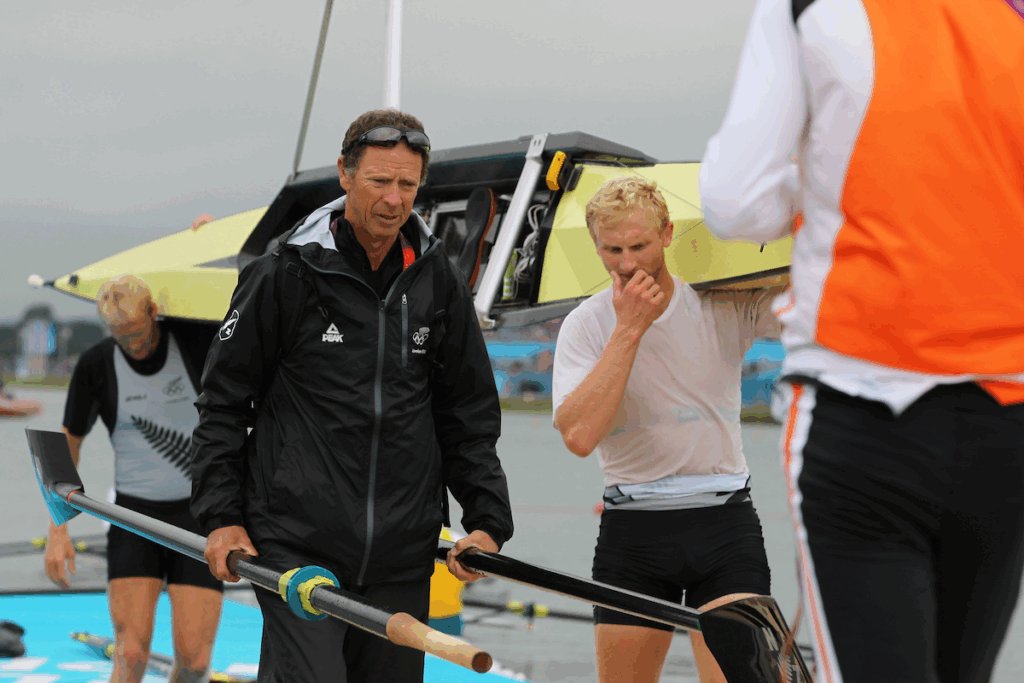
(Coach Dick Tonks and the Kiwi Pair, sourced from NZ Herald: https://www.nzherald.co.nz/sport/rowing-hamish-bond-lifts-lid-on-controversial-former-coach-dick-tonks/TFI7FIFXX7N7SGVOHDVVXAOSV4/)
Dick Tonks had been the cornerstone of the NZ program for a while, coaching most of their medalling crews, such as the Evers-Swindell twins at Athens and Beijing. He commonly only coached crews that he believed had good chances of winning, which was good news for Murray and Bond. Quoted from Eric Murray, “Dick Tonks was more living myth than man. He was reclusive, guarded, and hardly ever spoke, but we couldn’t give a damn. What he did do was coach champions, and that’s what we wanted to be.” The pair was hardly prepared for the onslaught of training they were about to receive.
Every piece was handcrafted to test an athlete’s mental capacity. He commonly started his sessions long before set times, and sent his boats off staggered based on their relative speeds to enforce a sense of competition. The group of boats commonly rowed more than 30 kilometers in a session, all trying to be the first boat back. Bond and Murray commented on the notable lack of breaks while under Dick’s coaching. “All we wanted was 30 seconds to take a gel, or grab some water, but under Dick’s watch, that was considered a luxury and therefore strictly out of the question.”
The little bits of praise and encouragement Tonks actually gave to Bond and Murray were never given directly. In fact, according to Bond, “We were told Dick had been overheard telling a reporter that he could tell just by looking at us that we were a fast boat, but he would have never wanted us to find out about that.” While the idea of vast mileages wasn’t new to the pair, especially Bond, as he also did cycling as a supplement to his training, the constant mental battle, consistent demand, and Tonk’s quiet nature were something entirely new for them. As Bond said, “We weren’t learning how to row as a pair; we were learning how to suffer as one.”
But the egregiously painful training and the grinding atmosphere to exorcize the demons of the past Olympics would pay off. As they finished the summer and prepared to leave for Europe for their first official race, “We had discovered something else: we could move the boat. Really fast.”
Revolutionizing Rowing
Leading up to World Cup 2, most of the media focus had been on the British pair of Andy Triggs Hodge and Pete Reed, who had won the Olympic gold medal in the four at Beijing last year. Like Bond and Murray, they too had set their sights on the pair. World Rowing had pictured them as the successors, far ahead of the field. For the Kiwis, this created a disquieting atmosphere. Bond said, “Were we going to be good enough to beat these guys? They were, after all, considered the two best sweep rowers in the world and the pride of the British rowing programme.”
June 21, 2009. Eric Murray and Hamish Bond sat on the starting line in their bright yellow Empacher Pair shell. Beside them were the favorites; the mighty British Pair of Andy Triggs Hodge and Pete Reed. They had achieved a dominant win at the last World Cup, a result that Bond said “Had reinforced the commonly held view that they were the crew to beat that season.” They had been touted by various press articles as “the new Pinsent and Redgrave”, two of the finest oarsmen in recent rowing history.
The air at the starting line was palpable with fear and tension as the boats lined up for the incoming dance of pain. The two-kilometer racing distance in rowing is commonly thought of as one of the most brutal tests of endurance and mental fortitude that an athlete can do, and the soon-to-be famous pair were about to go head-to-head with some of the most revered crews in the world.
And then the announcer spoke. “Hungary. Serbia. New Zealand. Netherlands. Great Britain. Czech Republic. Attention. Go.”
Sources:
- The Kiwi Pair, book by Eric Murray and Hamish Bond.
- Row2K, rowing news and photography outlet: https://www.row2k.com/features/3919/the-full-story-of-the-kiwi-pair/#:~:text=The%20salient%20facts%20of%20Hamish,)%2C%20captured%20six%20world%20titles%20(
- World Rowing footage: World Rowing Cup 2, Munich, 2009, Men’s Pair, used for describing race start: https://worldrowing.com/video/2009-rowing-world-cup-ii-munich-ger-mens-pair-m2/
- Photos:
Now I am impatient for part 2! Engrossing writing, making the scene come alive in my mind !