
Meeting Justin Levitt
(https://www.justinlevitt.com/)
By: Abinav Atreya
The piano is one of the most well-known instruments in the world of music. For hundreds of years, composers have come and gone, creating new and innovative ways of expressing love, hate, grief, sympathy, and so much more on 88 ivory keys. Unfortunately, the unfathomable popularity of the piano is also one of its few pitfalls. Composers can get drowned in the noise of the more well-known artists from long ago, such as Mozart and Chopin. However, the music that these modern composers create is equally as beautiful, unique, and stunning to both listen to and play. One of these composers is Bay Area native Justin Levitt.
Bay Area native Justin Levitt is a great example of a modern artist who can prosper in a field as old and complex as music. He has written for the Diablo Ballet, won a Telly Award for best music, was published in the Australian Music Examination Board syllabus, works at Steinway & Sons as the General Manager of Northern California, and far more.
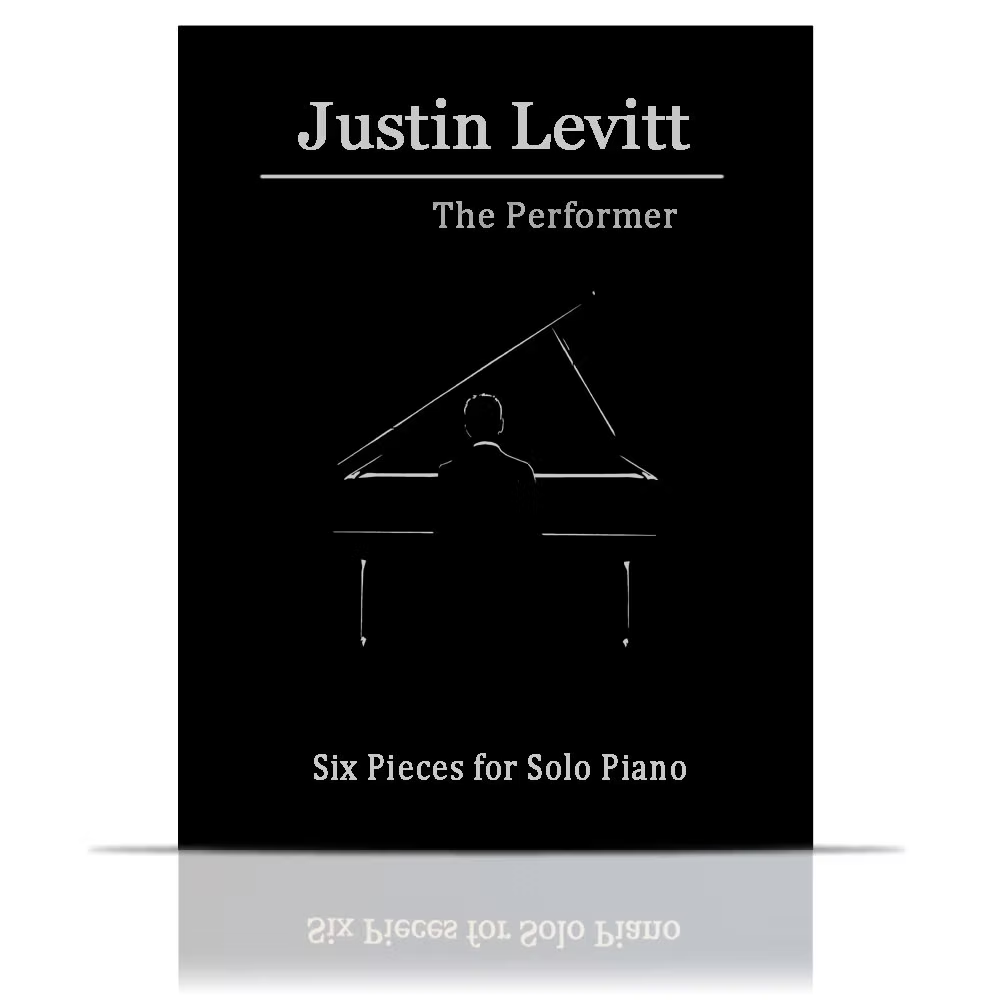
A very accomplished pianist, Levitt has also written books of his own. One of his most prized is his series of “Six Pieces for Solo Piano,” a few of which I have . I had the privilege of playing some of these pieces for him a few months ago at his store in Walnut Creek.
(https://www.justinlevitt.com/)
Learning the pieces:
Around the end of last year, my piano teacher introduced me to a book of compositions by Justin, called Looking Back. Looking Back features six pieces, of which she introduced me to the first one, called “Mr. Bach’s Wig.” A combination of the German Baroque style Bach played and more romantic elements, “Mr. Bach’s Wig” is a very interesting piece to learn.
The piece is split into three movements, titled “I,” “II,” and “III.” Each movement follows a very different format, from the fact-paced expressions of the first movement, to the fluid rhythm of the second, to the calm yet grand chords of the third.
The first movement was the hardest to learn of the three, mainly because I had not really played many pieces at this pace before. While fast, the hands need to be light and expressive, with rapid changes in volume being very common throughout the sheet music. Once you develop a feel for the music though, the movement becomes dramatically easier and is personally the most fun of the three to learn.
Conversely, the second movement came the easiest to me. I was far better acquainted with its fluid rhythm, and the slightly slower speed meant that it was easier to focus on expressions and clarity. It still came with its own challenges though. The slurred notes that it is easy to accidentally blur the notes together, instead of making them stand on their own. Combined with the use of the sustain pedal(which is used to blend the sound of notes together), it was somewhat difficult to master the still-quick nature of the piece while maintaining clarity and avoiding accidentals.
While the first movement is the most fun to learn, the third movement is by far the most fun to play. I am a fan of slow, chord-heavy music, and this piece is full of them. I enjoyed playing them, but learnt a lot about how to control the volume on my hands to be able to bring out the melody of the piece. Previously, I took chords as bell-tolls, smashing my hands into the keyboard to create sound. While it may sound nice, not all chords are like that, and this piece taught me how to restrain myself from turning the piano into a clock tower.
Playing for Justin:
As I was finishing learning the third piece, my piano teacher proposed the idea of playing for Justin. To be honest, I was initially hesitant. My fear of misplaying his pieces cropped up in my head, and I was unable to get it out. But I still agreed, and the date was set.
I spent a while preparing for the pieces, and it came together quite nicely when I was playing on my own. But what I needed to fix was my persistent stage-fright. Whenever I played for relatives or friends, I would choke up on sections that I would breeze through when playing for myself. Learning how to deal with this stage-fright, through breathing and practice was my final and perhaps most important lesson I learned from playing “Mr. Bach’s Wig.”
Looking back, I realized that I never needed to be afraid of playing for him.
On a Monday after school, my parents drove me, my piano teacher, and my sister over to Walnut Creek to Justin’s store. While it’s common to hear of people freaking out about playing for a composer, I felt oddly calm by the whole ordeal. Perhaps it was because of working on homework in the car, but I never felt the butterflies in my stomach that I expected to feel.
We parked in the parking garage, and walked over to the store. Immediately, he welcomed us in and we chatted for a while. There were an abundance of pianos, all completely different yet similar. Some were the classic Steinway black, others looked like glistening quartz, and some looked like polished wood. And then I asked if I could play his pieces for him.
Justin offered me to sit, and I chose a small, brown piano in the center. I played a single key, and I was struck by how different it felt. The heavier key and louder strings almost made it sound like a whole other instrument. I took a breath, and began.
Experience told me that I would choke up somewhere in the movement, but I didn’t. Instead of feeling nervous, for some unintelligible reason, I felt right at home.
I went through the first piece, then the second, and then the third, without any glaring chokes. Justin’s hospitality had diffused all my worries, and I had managed to play without worry.
Afterwards, he sat down and played the same pieces. He took a very unique take on them, which I hadn’t tried before. It was great hearing him play them out; his finesse of the keys was very evident. My playing, which I was pretty proud of, felt somewhat inadequate for a bit.
My sister also played for him, even though she had not been able to play piano at all in university. He was extremely patient and guided through it all. He then took us on a short tour of the pianos, and played a few other pieces of his. He also showed us a playback mechanism that seemed to perfectly replicate human playing, which was definitely interesting to see.
After that, we left. I felt very calm after, not because a huge weight had been lifted off my chest, but because I realized it had never been there in the first place.
How he composes:
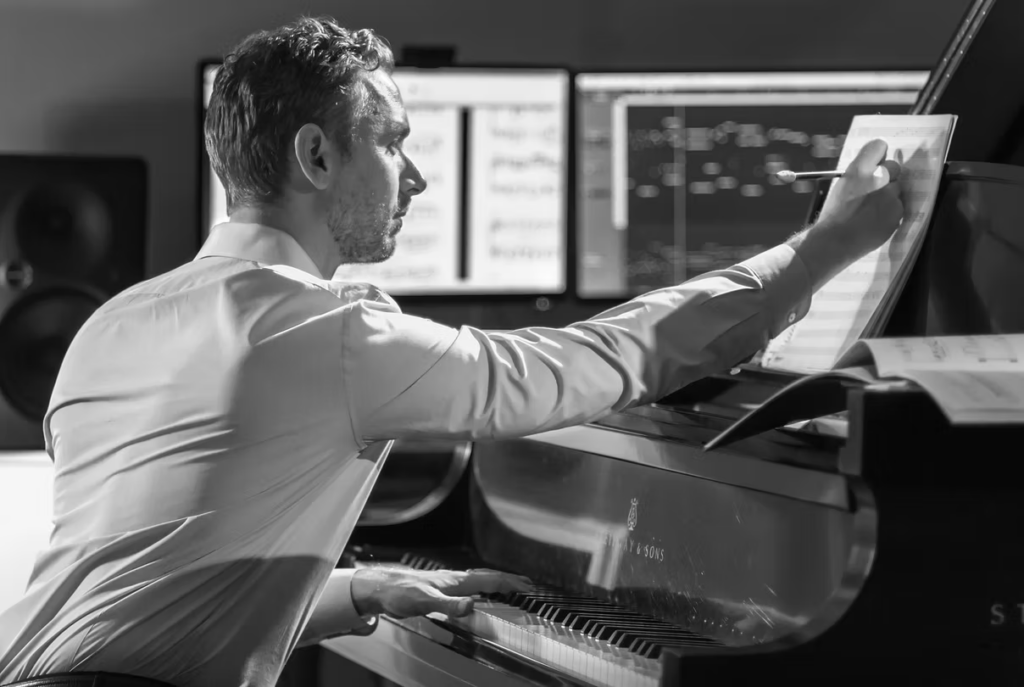
While talking with Levitt, I learned some surprising trivia. Namely that he was self-taught. For many of his pieces, he simply plays them out on his piano and writes it down. One would expect a much more formulaic method, but this way of composing clearly leads to great results.
Even if you don’t compose music, the idea of non-formulaic composing can still be translated into playing. I personally found that taking each piece in a more personal way, such as interpreting the message of a book, makes it much easier to play expressively, and “Mr. Bach’s Wig” sounded much better after I tried this method.
Concluding thoughts:
Meeting Justin Levitt was an experience. Of course, I learned a bit about playing the piano better. But, more importantly, I met a great composer, who somehow managed to dissolve my stage fright (hopefully not temporarily), and revealed that tried-and-true methods are not the only way to create something incredible. Simply following what you want to make, and refining your creative talent, can create things just as, if not more intricate, complex, and beautiful.
Abinav
I am very proud of you
Happy to see your confidence
and the perfection in playing in front of
Justin
Keep it up Abinav