
“Becoming Chinese”
Macoollette, shutterstock
By: Joy Ye
The idea of “Chinesemaxxing” spread rapidly on social media within the past few months, but what does the spread of Chinese culture as a trend really entail for the community?
Throughout the many trends and popular ideas that pass through social media everyday, one that surfaced a while back was the idea of “being at a Chinese time of your life” or “Chinesemaxxing.” Around two months ago, this trend gained traction as Chinese people started talking about their culture and exchanging ideas with others outside of their culture. People adopted habits like drinking hot water, taking their shoes off in the house, practicing Chinese medicine, wearing more Chinese clothing, and consuming more Chinese food. The culture became celebrated and appreciated across different platforms, and while that may be a good thing, the line between appreciation and appropriation is exceptionally thin, and the trend quickly devolved.
The boom of Chinese culture and media wasn’t a sudden occurrence. Even further back, around the first TikTok “ban” many users moved from the platform to 小红书 (RedNote), which is a popular Chinese social media platform. A similar cultural exchange happened then, where American users got to talk to Chinese users directly and a lot of the stigma that was built around the two communities dissipated as they interacted more. This exchange didn’t last very long as TikTok ultimately wasn’t banned, and many users moved back to the platform. The outcome of this short lived experience was that people were now exposed to Chinese culture. Eventually, these ideas resurfaced, and Chinese creators on western platforms started sharing their experience online, giving way to the Chinesemaxxing trend.
Once the trend became more popular, other creators who have been within Chinese communities would start to share their experiences, even though they weren’t necessarily a part of the ethnic group. While some of these creators came from a place of genuine appreciation, a lot of them felt like they were riding on the trend for the sake of it, ignoring the origin of the trend—an entire culture which has been around for decades, lived by actual people. A few Chinese creators started pandering their content to a White audience, commodifying their own culture to fit the Americanized perspective. It seems to be influenced by the “Model Minority” myth, where most commonly, Asian Americans are portrayed as the better, more successful, and adaptive minority. It also has to do with the idea of their “proximity to whiteness,” where non-white individuals align themselves with white-Eurocentric ideals to seek benefit from it. Even though they appeal to these ideals, it only gives them the illusion of protection. At the end of the day, if being Chinese is no longer cool or trendy, will these people they’re pandering to still be on their side? They’re still Asian, no matter how closely they align themselves with whiteness.
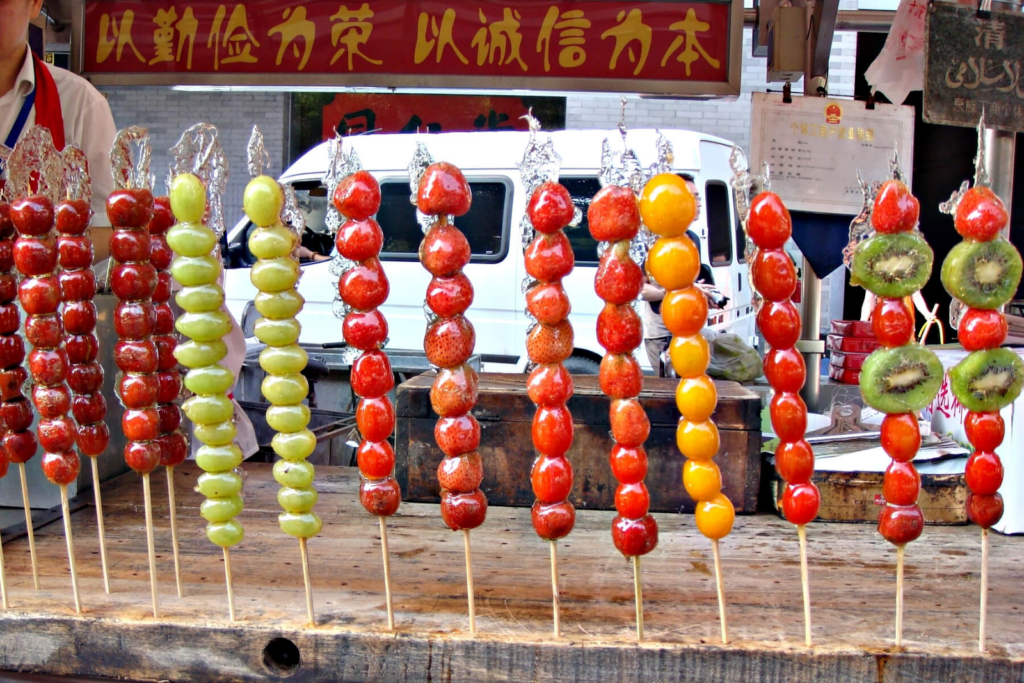
Soon, a rise of diluting the culture in a way to be more digestible to foreign audiences began to spread, removing it so far from its roots and creating something different. A recent example of this is with the snack, tanghulu (糖葫蘆), which is traditionally hawthorn coated in a hard sugar. More western variants of this food use fruits instead and a more syrup-like coating.While there is nothing inherently wrong with this, it ignores what makes tanghulu so special in the first place. Hawthorn by itself is extremely sour. The sugar is used to create a balance, making the treat appealing. Western variants lack this sense of balance between the two flavors. Furthermore, the Chinese origin of the food is often completely ignored, instead, being called Korean or Japanese because of how far removed it is from its origin.
White creators began to say that they’ve been “diagnosed as Chinese” and speak on tradition and culture like they’re experts on the topic. Again, there is nothing technically wrong with spreading the culture, but more often than not, they end up speaking over actual Chinese people. The voices of those whose cultures are being commodified become ignored. These white creators also tend to cover surface level topics, not bothering to dig deeper into the culture and understanding what’s really behind it. White creators, western companies, any group appealing to the Chinese trend benefit off of it, while many Chinese people are overshadowed. Others attempt to adopt the culture by saying that they don’t view Chinese things as foreign anymore, for example, saying Chinese food is just food. Instead of appreciating the culture, it only serves to alienate it further. The attempt to deracialize Chinese things like their food is unnatural, since it is impossible to remove it from its origin without appropriating it beyond recognition.
It’s hard to treat these attempts at accepting Chinese culture as genuine. Just six years ago, Chinese people were being discriminated against and at worst, being killed for simply existing as their ethnicity due to the rise of COVID. Things that are celebrated today would have been called disgusting back then. Would these people claiming to be Chinese today would have wanted to be Chinese then? Currently, White-Americans almost treat being Chinese like a costume. Something to take on and off at their convenience. They like it because it’s trending, a commodity they can take advantage of, and it seems like this trend might end up harming Asian communities in the long run. Chinese-Americans aren’t able to take off their Chinese identity whenever they want to, unlike White-Americans. Their culture is something they have to live by, from their lifestyle to the way they look. Because of this difference, the trend comes off as disingenuous, since for millions of people, this isn’t a trend.