
A Crisis of Trust — the Decline of Trust in Journalism
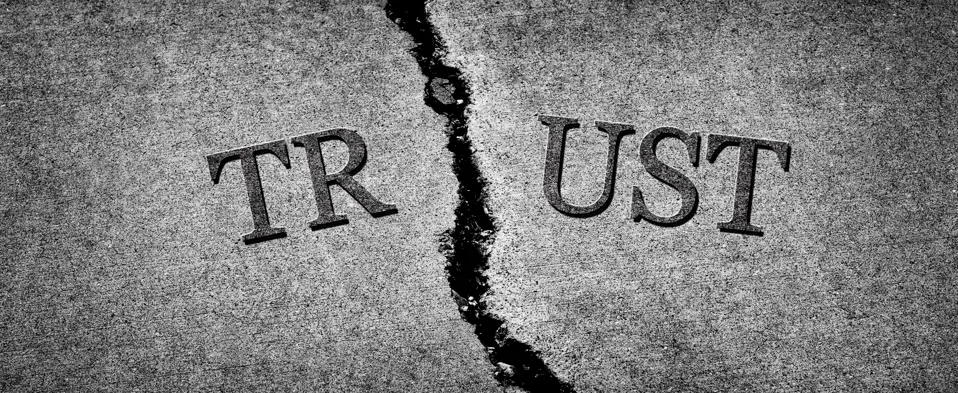
Image source: Forbes
By: Adi Kumar
Trust in mass media and journalism is at a historic low in the United States. What are the reasons for this crisis of trust? What are its consequences, and is there any historical precedent?
The press is considered the fourth estate of democracy. The role of the fourth estate is to act as a watchdog against the government and interests of the powerful by informing the public. It holds great power in its ability to shape public opinion and can even influence what is discussed. But when the press loses the trust of the public, it can have wide-ranging consequences. According to Gallup polls in the decades since 1970, it is at a record low—28% of Americans trust mass media to report the news fully, accurately, and fairly. What has caused this precipitous drop in trust, and what are its consequences?
Polarization
One of the main factors involved in the loss of trust is polarization. During and after the 1960s, the civil rights movement and its aftermath resulted in a political realignment that influenced modern politics. Essentially, the electorate and the politicians aligned themselves into two ideological parties over time: Democrats representing a more liberal progressive agenda and Republicans a more conservative agenda. This made the parties two separate groups with two different ideologies. People began to view politics from a partisan perspective. Another consequence of this is hostility towards the other party due to the formation of an ingroup and an outgroup.
Lack of trust can be a contributor and a consequence of political polarization. People tend to view media that doesn’t align with their worldview as biased against them, which is one of the largest factors in the decline of trust in mass media. Especially with the internet and social media offering more media choices than ever, people who disagree with a news source can seek out other sources that align with their worldview. Another contributing factor is that people, especially Republicans, perceive the news as liberal and biased.
The Internet and News Sources
There used to be limited choice in the news compared to now. You had major broadcast networks on television or radio, as opposed to the countless number of platforms and influencers that exist in the present media landscape. Looking back on the 1990s, conservative talk radio shows emerged. Rush Limbaugh, for example, pushed a highly partisan conservative messaging against what he portrayed as elite liberals by tapping into grievance. This, along with Fox News, contributed to further polarization. Republicans trust the media far less than Democrats. According to Gallup polls, as of 2025, 62% of Republicans do not trust mass media to report the news fully, accurately, and fairly, compared to 9% of Democrats who feel the same.
The rise of the internet fundamentally changed how news was viewed, especially for younger generations for a few reasons. For one, the internet changed the monetization model for news. The monetization of news on the internet is dependent on digital advertising and subscription services. Because of this, more sensational news with emotion-appealing titles are incentivized. Sensationalism like this distorts the truth. Also, online news is that high quality high factuality news tends to be paywalled, while lower-quality news tends to not be, making it easier for the falsehoods to spread.
Another factor in the internet age is social media algorithms. These tend to magnify partisanship. Algorithms aim for engagement, showing content that aligns with your worldview, or even content that upsets you in order to provoke a reaction. Oftentimes (I am guilty of this too), people do not read beyond the headlines. If people already have their mind made up and view headlines, they can have knee-jerk reactions to them. Maybe they will share it, and the link will get some clicks, making the publisher some money? Algorithms also create social media echocambers, which are environments where people are exposed to content that aligns with their worldview and thus, reinforces their beliefs. This can result in polarization and the spread of misinformation.
This is especially relevant because people are increasingly getting their news from social media as opposed to traditional news sources like cable television, although cable television is still the main source of news for most people. For example, about 21% of all adults and 39% of adults aged 18-29 regularly get their news from influencers rather than traditional outlets. This presents many problems for an informed public. Influencers tend not to have the media training that established outlets and networks have. It is also important to note that influencers don’t just talk about the news, but also mix in their opinions and entertainment. This can make it difficult to distinguish news from opinion.
The ability of the internet to spread false information and make it appear that a consensus agrees with it is highly damaging to the truth. Being unable to trust anything you see or hear can lead to disengagement from the news. Social media can make news constantly available, and such news tends to be negative. I believe that constant exposure to news and the horrific events that seem to constantly take place can desensitize people towards injustice and contribute to disengagement. It seems that when too much information is available, when the brain is barraged with knowledge, it becomes difficult to critically analyze the information presented. Instead of mistrust, there could be too much trust in a way, an uncritical acceptance. The Gallup polls asked if people trusted mass media to report news “fully, accurately, and fairly”. Evidently, most people do not. This reflects a broader distrust in institutions themselves. I think that most people do trust some sources of news, just sources they agree with.
Sources:
https://news.gallup.com/poll/695762/trust-media-new-low.aspx
https://www.pewresearch.org/journalism/fact-sheet/news-platform-fact-sheet/