What Does Kill You (Molecular Biology), Makes You Stronger (Receptive to Failure)
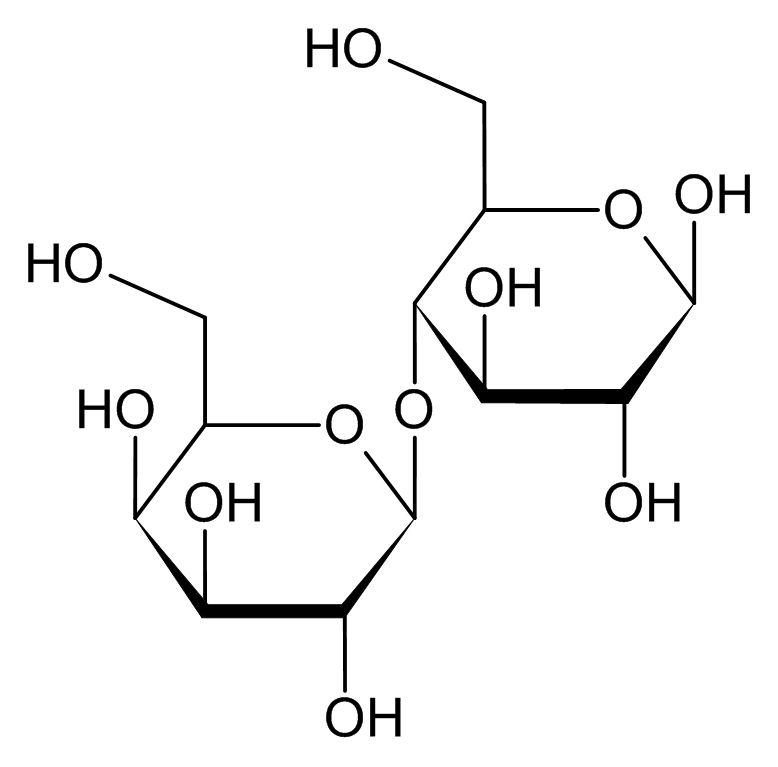
β-lactose molecule in Haworth projection, Assaiki, Wikimedia
By: Charlie Hoang
I have killed the student I was before, mourned him, and been reborn.
Did you know eating fiber is good for you because it helps you poop and prevents constipation? Did you know this is because our bodies cannot digest fiber? Did you know our bodies cannot digest fiber because we don’t possess the digestive enzymes to break down the beta-glycosidic bonds in cellulose? Did you know beta-glycosidic bonds form when monosaccharides undergo sugar cyclization and a hydroxyl group attacks the electrophilic carbonyl carbon, and pushes the hydroxyl group up to form a beta-anomer, which will then bond through dehydration synthesis with the hydroxyl group of another sugar? No? Well, now you know. That was week two’s lecture of molecular biology (BIOL-101A). In week one’s lecture of molecular biology, I didn’t even know what a hydroxyl group was.
I had my first molecular biology exam last week, six weeks into the semester. A lot has happened between week two (macromolecules) and week six (cellular respiration + exam review). For instance, I have killed the student I was before, mourned him, and been reborn.
1. The Killing
Before I started BIOL-101A, I knew it would be difficult. A friend of mine told me, “I thought I didn’t have a life when I was taking ochem, but biology is so much worse. I don’t see the sun.” I heard that and still decided to add it to my course load, knowing I would also be juggling college applications and Chemistry II. If I heard that now, I would think, “Good thing she doesn’t require photophosphorylation to drive ATP synthesis.”
Back then, I was confident I could ace my very challenging science courses this semester while crushing college app material, working and completing my tutoring training, going to the gym six times a week, maintaining my reading streak, sleeping 8 hours a night, and hanging out with my friends. What.
Somewhere two to three weeks into this semester, when the deadline to add and drop classes without consequence had passed, I began to regret my decision. Comparatively, it took just the first week for one of my classmates to drop BIOL-101A and transfer to BIOL-102 (Intro to Biology for Health Sciences). The semester had only just begun, and the material already felt impossible. There was so much to review and memorize. By the time I finally understood how to convert Haworth projections to Fischer projections and memorized the 20th amino acid, we had moved on from carbohydrates and proteins. My professor ended this section by informing us that “if you thought this section was challenging for you, you need to reconsider whether or not this is the class for you. It will only get harder.”
As she said this, I looked around at my classmates to see if any were freaking out as I was. Now I was a little distracted because the carbonic acid-caffeine combination from my Red Bull was eating away at my insides, but I was pretty sure everyone was chilling.
I didn’t realize it then, but this was the beginning of the end. Before this semester, I couldn’t handle caffeine. I could drink one matcha latte every two weeks at most because I would tremble with anxiety for the rest of the day. I hated coffee not just because it tasted disgusting, but because the caffeine gave me a headache. Since week two, coffee and Red Bull have been incorporated into my diet in moderation. Which, for me, is catastrophic. Furthermore, contrasting my profound distress over the material with my classmates’ indifference killed my confidence. I had asked multiple classmates what they thought of the material so far, and the consensus was “it’s fine.” The consensus was not “I don’t understand anything, and I don’t know organic chemistry concepts because the prerequisite was general chemistry, and I think this is severely hindering my understanding.” I couldn’t tell if it was my intelligence, my idleness, or my character causing this disparity. I was relearning all the lecture material as soon as I got home. I was putting it all into my Anki flashcards and reviewing them every night. I was drawing every structure and blurting every topic on paper every two days. My screen time was the lowest it had been since I first got a phone (yikes). Still, I hadn’t reached “it’s fine” status. And when I thought I did, my professor would give us a pop quiz and dispel my folly.
I was frightened. I was neglecting my college applications, trying to keep up with biology and my other classes. So, I decided to visit my high school counselor and ask him for some advice. He essentially reassured me that the class was indeed very challenging and that the students who had taken it before me had similar experiences. He then asked me to reconsider what my goals were for the class. He asked, “Are you looking to pass?” to which I had a visceral reaction. I had never gotten anything less than an A in high school, let alone a C. The words of my college counselor rang through my head: “If you can’t get an A in bio, you should take it at a different college.” There was no option. I had to get an A.
I thought I was set on this, but as weeks four and five rolled around, I started to pay closer attention to my classmates. I realized many of them were also taking organic chemistry, and some of them were either applying to or already in grad school. Listening to their side conversations, I also realized that we were the same level of confused (which was very). At this point, I had become more accustomed to the workload and adjusted to my new study habits. I knew I was learning a great amount of new material, even if I wasn’t mastering all of it. I was consistently scoring 9/10s on quizzes and lab worksheets. I felt oddly at peace with equal amounts of chaos surrounding me; I was stuck with the same sucky course load, schedule, and responsibilities. But there was now a thought forming in the distance: “I would lowkey be okay with getting a B in this class.” In other words, death was knocking at my door. And I was ready for it.
2. The Mourning
I was mostly ready for it. I didn’t spend 16 years of my life overly invested in my academics for my entire perspective to shift without a little pushback. I was worried that I had just become lazy and lowered my standards. After all, BIOL-101A is a required class for pre-med students, and I am a prospective pre-med student. It follows that I should perform well in the class. “Well” has always been defined as getting the highest grade in the Ohlone book. “Well” has always been studying ahead and knowing the answers in class. “Well” has always been, “I can’t believe you’re in high school!” It’s been more than the ability to keep up, but to excel.
As I began repeating “I’ll be okay with a B,” when I felt like a quiz went wrong, or when my professor admonished our class performance, I could feel my latte curdling in my stomach. I was looking at my future. In two months, I won’t be able to tell people I’m 16 and revel in their amazement. In two months, it will feel like my achievements have been reduced by another year in my life. As I grow older, my capabilities grow less and less impressive. I had convinced myself that if I just got better and better each year, if I succeeded in harder and harder classes, that my fears wouldn’t be true. But in the midst of college applications and resume-maxxing online, that funny feeling creeps up on me. I’m not doing, achieving, stressing, worrying, working hard enough.
Last year I told my counselor that I hadn’t done anything significant in high school. Laughing, he responded, “No one does anything significant in high school.” I then told him I was having a mid-life crisis. He said, “At 15? I hope not.”
3. The Rebirth
Now, I sit at the precipice of commitment. My time, the time I’ve been continuously wasting and chasing and vying for more of, has come to an end. The early decision deadline is four days away. There is nothing more I can promise myself that I will achieve. Which means there is no more room for me to disappoint myself when I eventually break that promise. It is the most oppressively freeing feeling knowing that once the decision finally comes—whichever college chooses to reject or accept me, my biology final grade will be inconsequential. If the lesson I learned was that a letter grade doesn’t define me, then I’ve realized it. In 2 months, I will turn 17. A week later, I will receive an email, (with subject line: “Status Update”) and know if I was successful or not. I will then, regardless of the outcome, be grateful to have been finally defined. I will breathe. I will not think about the glucose oxidizing in my body when I do.
Leave a comment