
Artemis II: Bound For The Moon
(https://www.sciencefocus.com/space/launch-of-artemis-2-in-pictures)
By: Amber Wallis & Abinav Atreya
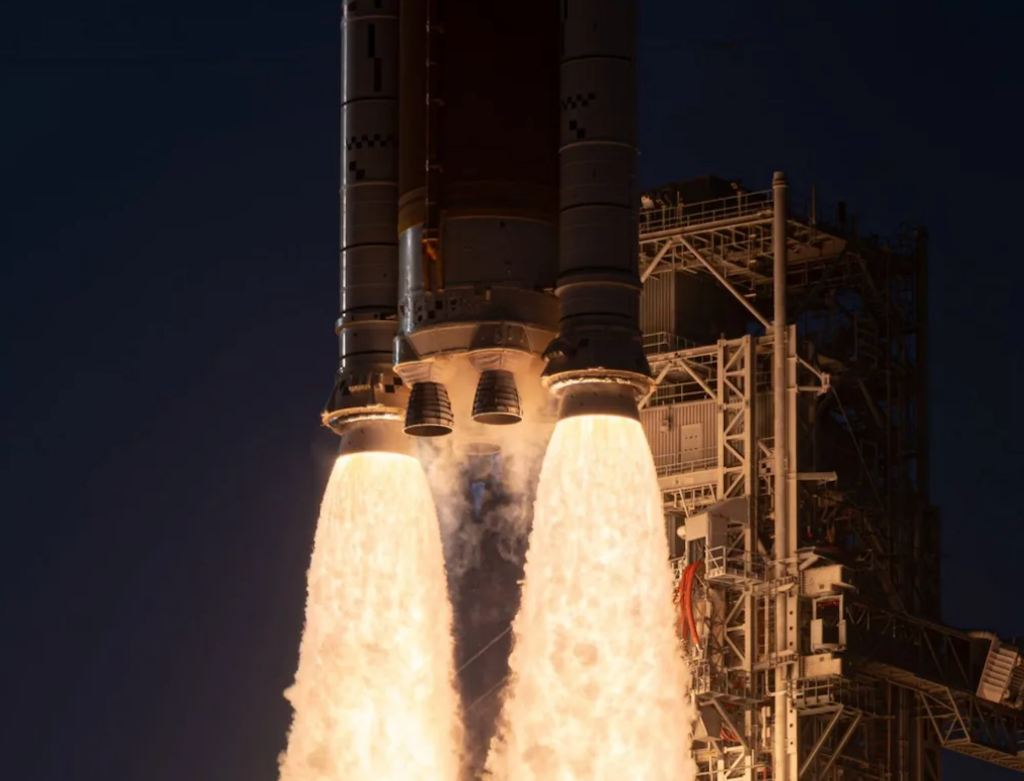
“And liftoff! The crew of Artemis II now bound for the moon! Humanity’s next great voyage begins.”
(Disclaimer: this was partially written before the mission ended)
NASA’s Artemis II mission, on April 1, 2026, flew 4 astronauts around the Moon. Artemis II was a step toward NASA’s return to the Moon and opens many opportunities for future use of the Moon and its resources.
Artemis II was the second mission in the Artemis Program. In 2022, Artemis I was the first mission for this program, when NASA autonomously tested the Space Launch System and the Orion spacecraft’s systems. This time around, the Orion capsule carried four astronauts on a test run to fly around the moon and back. Orion is built for longer missions in space than the Apollo Missions of the late 1960s and early 70s. Over the past few weeks before launch, engineers have focused on repairing the spacecraft after finding a helium leak in the liquid hydrogen tank. Errors from Artemis I have also been considered for this mission, such as the heat shield and power distribution, and have also been repaired. Due to these instabilities, there have been concerns about the crew’s safety on Orion. To fix the issue of the heat shield, NASA has done extensive testing and altered the spacecraft’s planned path to reduce char and stabilize thermal performance. While these conditions didn’t drastically affect Artemis I’s mission outcome, NASA has reviewed these issues for Artemis II, as any problems could affect the crew’s survival during the mission. Another key machine for the mission is the Space Launching System, an expendable launch vehicle that uses multiple engines to propel the rocket into space. The SLS is located in the Kennedy Space Center in Florida and plans to take off from launchpad 39B. Both the launcher and spacecraft arrived at the site on March 20, 2026.
A Short History:
The Artemis Program is not the first of its kind. After the closure of the Space Shuttle launches (missions to low earth orbit to provide routine transportation for crew and cargo), NASA was already working on new missions that could start using the shuttle-era technology. The result was the ill-fated Constellation Program.
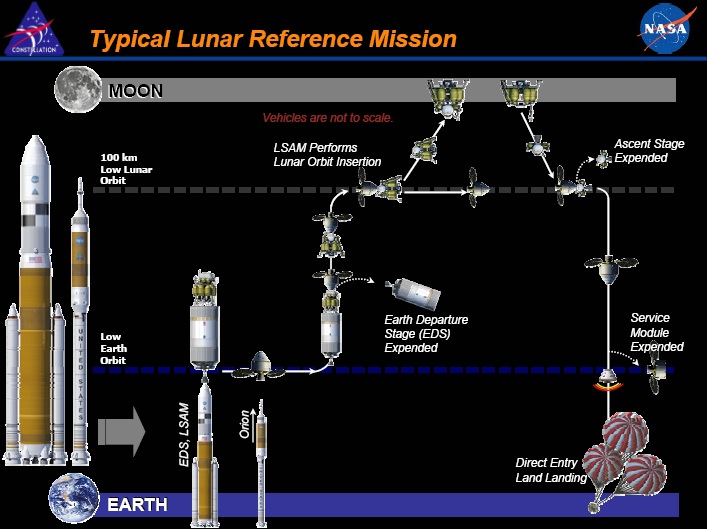
The Constellation program would have been a program to get to the Moon and Mars. It consisted of two designed rockets; the Ares I and Ares V. The Ares I was crewed. It would deliver the constellation crew to the spacecraft they would use to go to the Moon or Mars. The Ares V was a massive cargo launch vehicle, which would send the parts of the spacecraft to orbit to be put together like the ISS.
(https://commons.wikimedia.org/wiki/File:Nasa_constellation_program_for_moon_mission.PNG)

It was an ambitious project; too ambitious for NASA’s budget. The program quickly spiralled out of control and sank millions of dollars, and was eventually cancelled in 2010 in a NASA budget cut. Their agency needed a new way to reach the stars.
In the end, NASA again opted to base their new launch system off shuttle-era technologies. The Solid Rocket Boosters and Core Stage of the SLS are based on the SRBs and RS-25 engines on the Space Shuttle. But the other part of the SLS, the Orion crew compartment, is actually derived from the Apollo Missions (The first moon landings). By combining technology from both programs, NASA was able to develop a new launch system reliably capable of deep-space missions. While not as ambitious as the Constellation programs, the agency was still able to pull a launch system together that could get the job done.
The Crew:
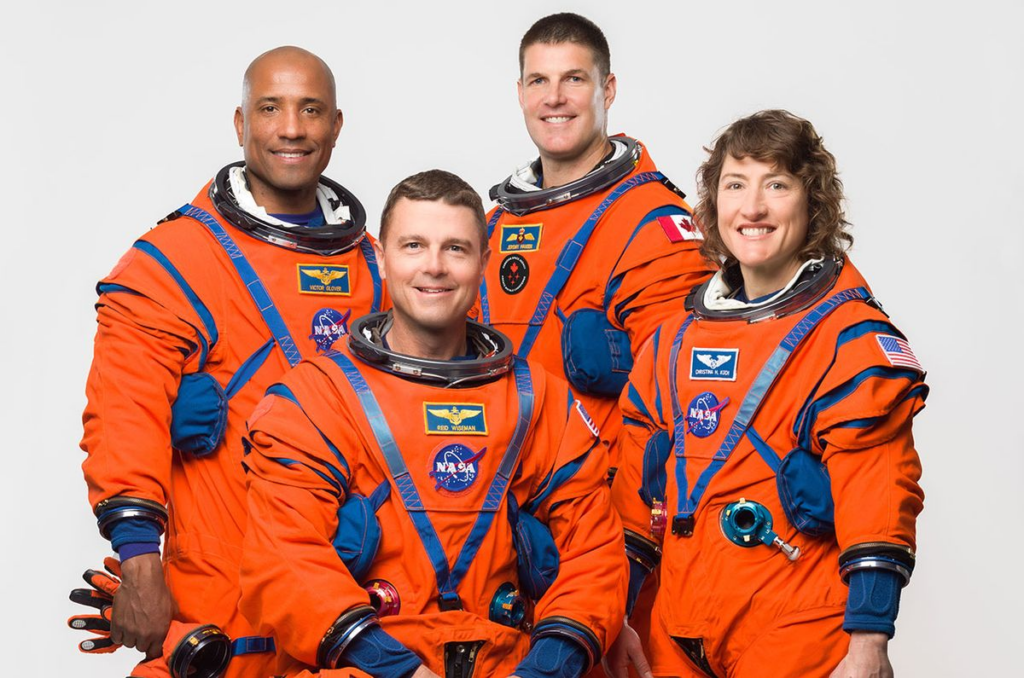
Artemis 2 was crewed by Commander Reid Wiseman, Pilot Victor Glover, and Mission Specialists Christina Koch and Jeremy Hansen.
(https://www.space.com/nasa-names-artemis-2-moon-crew)
Wiseman is a former Navy pilot and previously spent 165 days aboard the ISS in 2014. He is renowned for his calm leadership and boasts widespread experience in aviation and spaceflight. He’s held prestigious leadership positions such as Chief of the Astronaut Office, and has performed two spacewalks.
Victor Glover served as the mission’s pilot. He flew on SpaceX’s Crew-1 mission and also worked in the Navy, as a deeply experienced aviator and test pilot. He has completed four spacewalks, totalling 26 hours. He is also the first Black astronaut ever assigned to a lunar mission.
Christina Kock was a mission specialist. Before Artemis, she set the record for the longest single spaceflight done by a woman after spending 328 days, almost a full year, in space. She previously worked on critical instruments for NASA’s Juno probe to Jupiter, and has helped conduct over 200 scientific investigations during her time in space.
Jeremy Hansen was the other mission specialist and also represented the Canadian Space Agency on the mission. A former Royal Canadian Air Force colonel, Hansen previously worked as an astronaut trainer and communicator at mission control before becoming an astronaut himself. While Artemis II is his first mission, he has spent years supporting missions behind the scenes.
The Future:
Artemis II, in all aspects, was a mission success. Victor Glover reported that the spacecraft handled better than the simulated characteristics they trained on, and all mission systems critical to the mission proved themselves with human crew on board. The crew successfully spaced down on April 10th, 2026, after travelling further from Earth than any spacecraft before.
But for all its success, Artemis II was only the second step in a vast future of Artemis missions, designed to establish a consistent human presence on the moon and launch us to Mars. Artemis III, in mid-2027, will be a test flight of the Orion module’s docking with SpaceX’s Starship or Blue Origin’s Blue Moon, both of which are intended to be landing craft. If all goes well, Artemis 4 will finally return humans to the moon in late 2028.
It’s hard to tell what exactly the future will hold for the rest of the Artemis program. Their end goal is to establish a moon base and a constant human presence on the moon by 2032, but if the viewership of the Apollo Missions shows anything, it’s that public interest in the program might fade by this point. Thankfully, with the impeccable track record of the missions and the momentum from Artemis II, there is a very good chance that these goals will be accomplished within their time-frames. We just need to hope that the momentum carries us further—perhaps all the way to Mars.
Sources: