
The Fall and Future of the Golden State Warriors
Source: Reuters
By: Adi Kumar
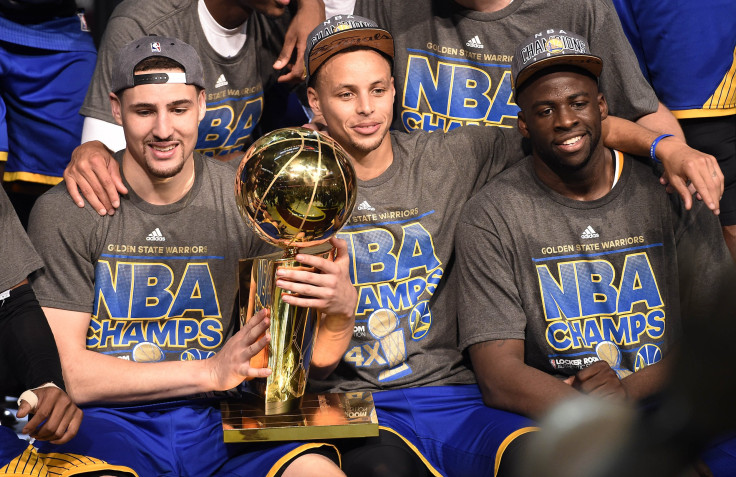
The Golden State Warriors of the mid to late 2010s are largely considered one of the greatest teams of all time. Led by a core of Stephen Curry, Klay Thompson, Draymond Green, and later, Kevin Durant, the Warriors won 3 championships in 5 years, and one more without Durant a few years later. Despite the hopes of the Warriors organization and the fans, the days of the Warriors dynasty are over. How did the Warriors build this dynasty and how did it decline?
From 2015-2018, the Golden State Warriors won three out of four championships, achieved the all-time best NBA regular season record of 73-9, and revolutionized the way basketball was played. Now, that era of greatness has come to an end. How did the Warriors become so great?
The Rise
Curry was selected with the 7th pick in the 2009 NBA draft by the Golden State Warriors, a team largely considered an afterthought in the league. While his shooting ability was never in question, Curry’s small-frame and lack of athleticism led to Curry’s ability to succeed being questioned. His early career was plagued by ankle injuries further adding to this doubt. But Curry proved his skeptics, and even his supporters, wrong when he won MVP in the 2014-2015 season and the first and only unanimous MVP the next season. In the finals that year, the Warriors defeated the Lebron-led Cleveland Cavaliers 4-2. However, like all successful teams, this wasn’t achieved by one player, but a well-rounded roster and a winning coaching strategy.
One key change to the front office was hiring Bob Myers as GM in 2011. The GM of a team is responsible for drafting, trading, and negotiating contracts with players. Thus, they have considerable influence over a team’s roster construction. With Myers, the Warriors won 4 championships in the span of a decade, proving his ability to make winning decisions.
The success of the team was largely built through drafting the right players. Klay Thompson was added to the team in 2011. He and Curry would become known as “the splash brothers” for their prolific three point shooting. Draymond Green was drafted in 2012 in the second round. This pick would prove essential to the Warrior’s success, as Draymond developed into an elite playmaker (the key facilitator of the offense) and one of the best defenders of all time.
Other important players were added through signings and trades. In 2012, the Warriors traded for a more defensive-minded center—Andrew Bogut—who proved reliable in the playoffs. One of the last key players added was Andre Iguodala. This proved to be one of the best additions for the Warriors, adding playoff experience, willingness to play within the system, and elite defense, all while unlocking a positionless small-ball lineup that would catch opponents off guard with a deadly combination of playmaking, speed, defense, and shooting.
Another factor that propelled the Warriors to success was the addition of Steve Kerr as head coach in 2014. Kerr had been around the league in multiple winning teams. He played for the Chicago Bulls during their second three-peat and for the Spurs, winning two championships there. He coached Team USA with coach Gregg Popovich, who is one of the greatest coaches of all time. His system of high motion basketball focused on passing and movement inspired Kerr to implement the same for the Warriors team. The key difference being the Warriors had two of the best shooters of all time. Kerr also took inspiration from Phil Jackson’s triangle offense, creating a hybrid offense built around the pick-and-roll and motion that leaves defenses at a disadvantage.
The Dynasty
The team was fundamentally built around Stephen Curry. His ability to consistently make difficult three point shots coupled with his constant off-ball movement and screening made him the subject of significant defensive attention. The constant attention Curry draws creates more opportunities for his teammates. With this roster, in 2015, the Warriors won their first NBA championship against the Cavaliers. And the next year, the Warriors won an NBA record of 73 games with nine losses, surpassing the 1995-1996 Bulls 72-10 record. Despite the record, the Warriors lost the finals in a heartbreaking fashion, blowing a 3-1 lead in the finals to Lebron’s Cavaliers. The Warriors had to make a change after this collapse to ensure it never happened again, and did just that over the offseason. The Warriors organization recruited Kevin Durant, one of the best scorers in the league and former MVP (who just lost to the Warriors in the Conference Finals). The already elite Warriors team that made the finals for two years in a row had just become absolutely unstoppable, making the Western Conference a foregone conclusion. It was obvious who would be in the finals next year—the Warriors and the Cavaliers.
With Durant, the Warriors coasted through the regular season, easily finishing with a 67-15 record in the 2016-2017 season. For the next two years, the Warriors dominated the regular season and won two championships against Lebron and the Cavaliers. But despite the roster’s talents, the road to the finals was not easy—the Rockets pushed the Warriors to 7 games in the 2018 Conference Finals. In 2019, the Warriors looked to achieve the legendary three-peat, a feat only achieved by the greatest Lakers and Bulls teams. The Warriors made it to the finals, but an unfortunate series of season-ending injuries occurred: Kevin Durant tore his achilles tendon, and Klay Thomspon tore his ACL. The short-handed Warriors ended up losing the series 4-2.
The Decline, Resurgence, and Decline
Following their loss in the finals, the Warriors declined substantially. Durant left in a sign-and-trade in exchange for D’Angelo Russell, and Thompson was rehabbing his ACL. Clearly, the Warriors were no longer the undefeatable juggernaut they once were. Russell, despite his scoring ability, lacked the defensive effort and skill set to be a good fit for a Warriors team. Russell was then traded for Andrew Wiggins, who as a wing, fit better into the Warriors system and roster. Regardless, in the following season, the Warriors went 15-50 (in part because Curry was injured, in part because they were tanking for a draft pick) and missed the playoffs the next year.
But this was not the end for the team just yet. The roster was re-tooled. The team added players with emphasis on basketball IQ and defense, such as Otto Porter Jr and Gary Payton II. Klay returned, though he was limited by his injuries. Jordan Poole was drafted in 2019 and developed into a skilled scorer. Wiggins, who had a reputation for not improving on his old team, put more effort into defense and efficiency. Curry and Draymond remained dominant. In 2022, the Warriors made the playoffs and managed to win against the Boston Celtics. This was largely made possible by Poole’s and Wiggin’s improvements.
However, this resurgence was relatively short-lived. The following years were characterized by drama and the effects of age. In 2023, Draymond Green punched Poole, with minimal details coming out about the incident. Poole already had issues with his play, such as bad shot selection, but this incident was likely the final straw that resulted in his trade. Wiggin’s play became worse as he struggled with family issues, and Klay struggled with the lingering effects of his injuries. Some role players aged out and retired. Then, in 2024, Klay was traded to the Mavericks, separating the trio that brought the Warriors success. To many Warriors fans, it was heartbreaking to see the Warriors core broken up.
Now and The Future
Last season (2024-2025), Wiggins was traded for Jimmy Butler. .Butler reinvigorated the Warriors, providing effort on both offense and defense as they went 23-8 in the second half of the season. While the Warriors did make the play-in and playoffs, and beat the up-and-coming Rockets in 7 games, injuries plagued the team, with Curry and Butler both getting injured. The team, despite flashes of excellence, struggled at times with a stagnant offense despite Curry’s continued excellence.
While the Warriors have drafted at high picks since 2019, they haven’t been able to replicate their past drafting success. James Wiseman, the 2nd pick from 2019 was a raw prospect who turned out to be a bust. In 2021, Jonathan Kuminga was selected as the 7th pick. While he has shown flashes of skills and athleticism, there are rumors of friction between Kerr and him due to inconsistent role and playing time.
Now, the Warriors dynasty seems finally over. Prospects of a resurgence similar to 2022 no longer exist. The core is old: Curry is 37 years old, Draymond 35, and Butler 36. The team does not have the trade pieces to retool. It seems that the Warriors, at least until Curry retires, will remain decent, but not great. The team is set to turn a new leaf in 2026-2027, when Curry, Draymond, Butler’s contracts all expire. That will be the end of the Warriors I know, the end of an era. But I can look back on all the successes (and failures too) and be grateful for the greatness and beauty of basketball that I witnessed. The selflessness and pace, the motion, the defensive grit, and clutch plays will always be the image I remember of the Warriors.
Sources: